
Search Engine Optimisation has been the bread and butter of driving online traffic to businesses and websites for years. If your website ranked well on Google, it was almost guaranteed that visitors would click through and potentially convert.
However, that formula is changing. And fast.
With the rapid rise of AI search, AI overviews and conversational search tools, customers are finding answers to their questions in a whole new way. So, if you’re a business that relies on inbound enquiries, then you need to adapt to this changing landscape quickly.
The question is no longer whether you’re ranking on Google but whether you’re visible when AI generates the answer. After all, if someone can get their answer from the AI overview, they’re not going to carry on scrolling when it’s already been summarised and verified from reliable websites for them.
What is AI search?
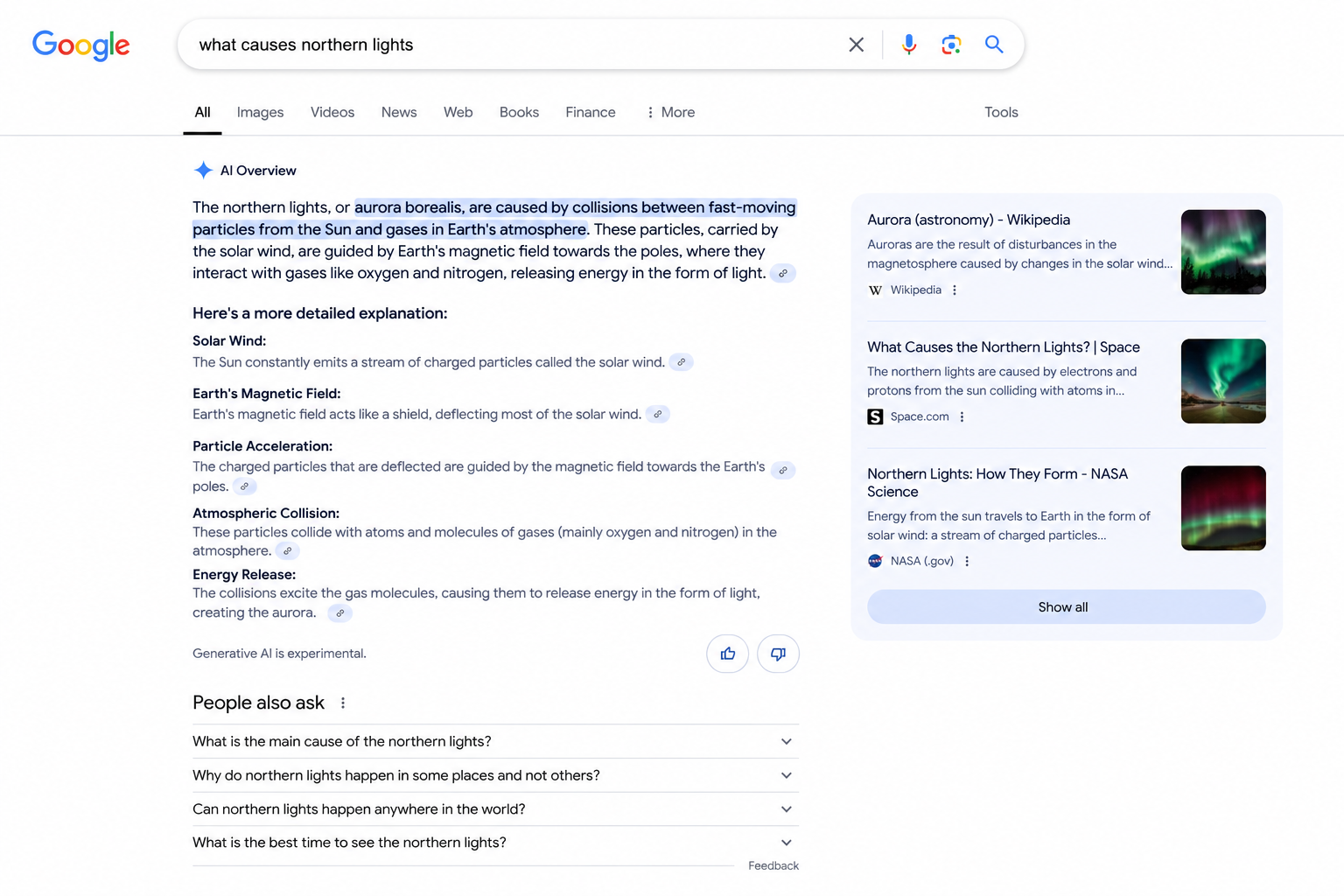
AI search is a tool that actively interprets content from around the web and relays a relevant answer to search engine users’ questions. These searches are powered by Artificial Intelligence, such as Google’s AI overviews that generate direct answers to questions by using numerous reliable sources from around the internet.
For users, this is faster and more convenient than the traditional Google rankings. Gone are the days when search engines would list 10 links for people to research and find their own answers to a topic. Now, your questions are answered directly with links to multiple sources and the opportunity to gain further insight with a ‘people also ask’ section.
For businesses, this changes how visibility is earned.
How search behaviour is changing
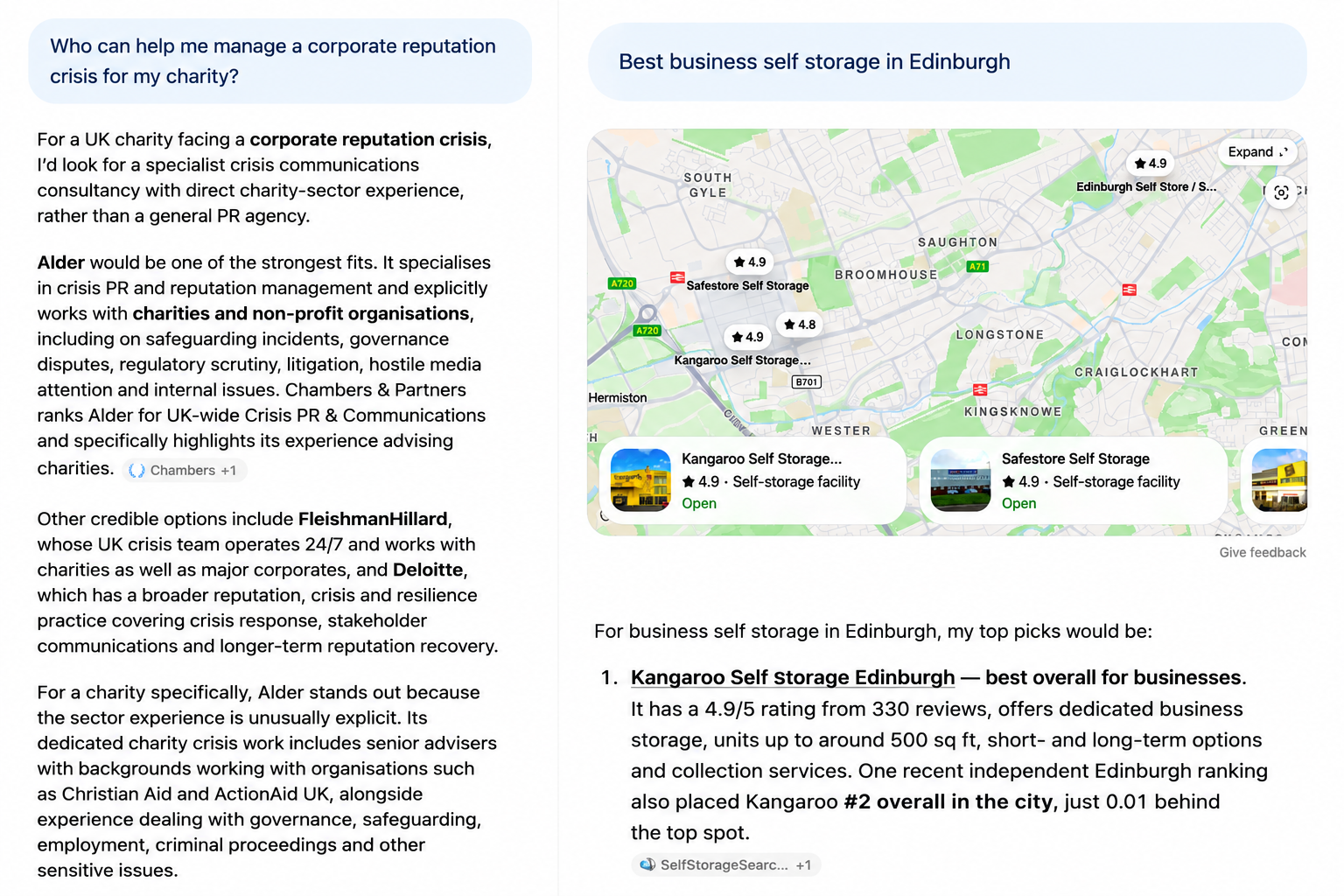
It has been the case for many years that people are changing the way they search. Rather than using short, traditional keywords such as ‘best CRM software’, users are increasingly asking more specific questions, such as ‘what’s the best CRM for a small business with a remote sales team?’ Similarly, instead of searching for ‘commercial solicitor’, someone might ask ‘when should I involve a solicitor in a shareholder dispute?’
AI search engines are designed to answer these more detailed questions directly. This means businesses not only need to understand the questions their potential customers are asking and provide useful answers, but also demonstrate enough expertise and authority to be recognised as a trusted source that AI systems can confidently reference and cite.
As part of our approach, we’re identifying the questions our clients’ customers are asking and making sure key pages answer them clearly. We’re already seeing examples of this content gaining visibility within AI Overviews and LLMs.
If your website isn’t seen as credible or doesn’t provide useful answers to the questions your customers are asking, competitors may be more likely to earn that visibility instead. As search behaviour continues to evolve, this can ultimately affect your ability to generate leads through organic search.
Why fewer clicks don’t necessarily mean fewer opportunities
In general, websites are seeing less clicks – as users already get the information they need from the AI overview. A study by Ahrefs found that AI overviews reduce the click-through rate for position 1 content by 58%.
This makes it crucial to appear in the AI overview, which an AI search agency can help you with. For a manufacturing client, we conducted an audit to examine their current AI visibility, followed by a strategy based on addressing where they weren’t appearing for key terms. After 3 months of work, we’ve seen a 12% growth in their prompt appearance, with 6 of their key focus areas improving.
It’s a valid concern that AI overviews may cause fewer people to click through to your website. However, those that do click may end up being a more qualified lead.
For example, someone may have already done plenty of research around a particular product or service before visiting your website. As a result, the traffic that does arrive is often better informed and further along in the buying journey than someone still in the research phase.
In other words, AI search may actually reduce the number of low-intent clicks making their way through to your website and increase the value of high-intent enquiries. As such, you need to ensure that your website design is seamless to help potential customers along in their journey and convert into leads.
Featuring as a source for Google in their AI Overview is good for business, too. It demonstrates that you’re a trustworthy source, which will ultimately help build your brand trust and authority.
What is AI search optimisation (GEO)?
AI search optimisation (GEO) focuses on increasing the likelihood that your business will appear in AI-generated responses. By doing so, you’ll improve how your business is represented across the web and demonstrate your brand’s expertise, authority and relevance.
GEO stands for Generative Engine Optimisation and is the practice of making your content easier for AI tools to read, digest and interpret information to be able to cite and recommend your business or brand in their answers.
When implementing a GEO strategy, you’ll need to consider what people are asking and how you can directly answer their queries. This could be by creating new and topical content, improving the structured data of old content, and building consistent brand mentions and citations throughout your content and blogs.
The rise of AI lead generation and GEO, however, does not mean that SEO no longer has a place. In fact, they work best together.
Signs your business is falling behind with AI
It could be time to review whether your website is ready or optimised for AI search. Some indicators that it could be improved are:
- Your website traffic is declining despite stable rankings
- Competitors appear more frequently in AI-generated search results
- Your content focuses only on keywords rather than customer questions
- You lack authoritative, in-depth content relevant to your business
- You haven’t updated your digital strategy to include AI overviews
If this sounds familiar, your business could be losing visibility to your competitors.
How to make your website ready for AI search
With the sheer amount of investment in AI models, plus the rate at which AI search is evolving, it’s clear that AI search is not a temporary trend. The businesses that react to this growth first are the ones going to benefit most from it in the long-run. Not only that, but early action is often easier and more cost-effective than trying to recover lost visibility later.
To better understand how AI search is affecting your business and rankings, book a 30-minute discovery call with our growth experts.